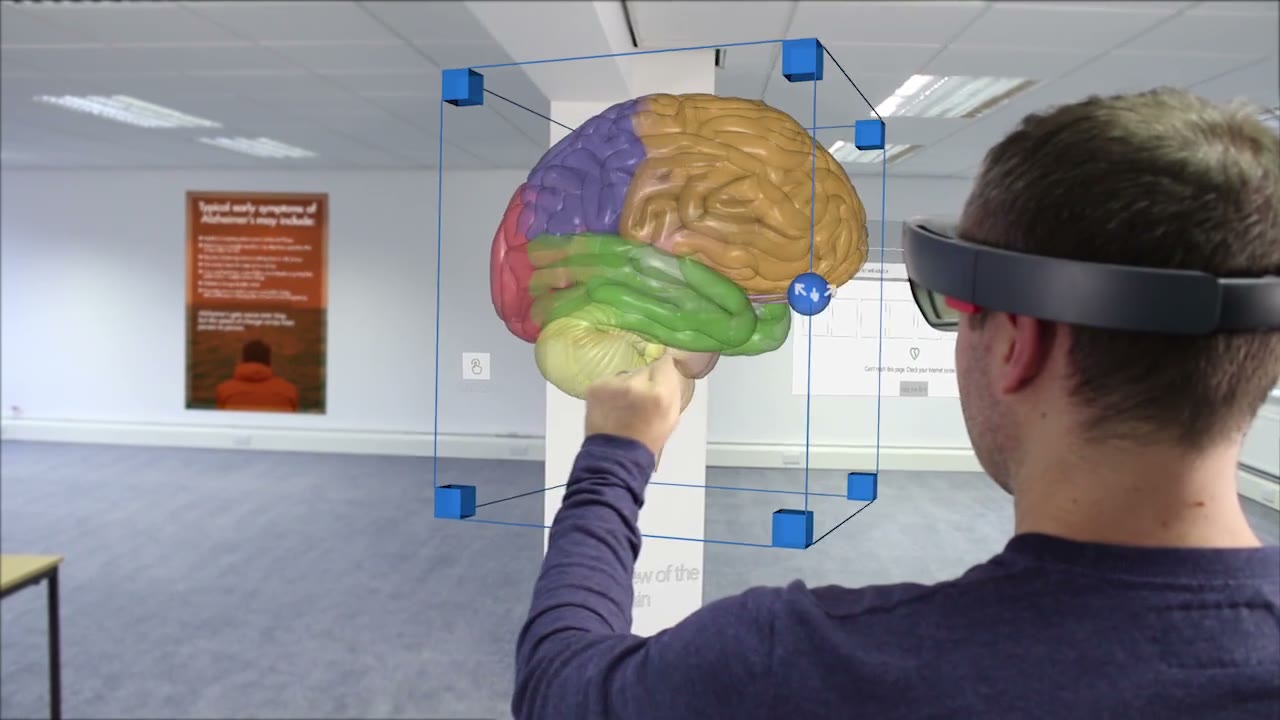
Microsoft has stopped making HoloLens. Production has ended, Windows Mixed Reality has been deprecated, and the support window has a date on it. If you have a mixed reality build running on HoloLens right now, it has a shelf life.
I built on HoloLens for years, so this is not a hit piece. It did things nothing else could at the time. But if you own one of those builds, the useful question now is where the work goes next.
What HoloLens was actually good at
Two things, mainly.
The first is that you could see the room. A clinician wearing one could still see the person they were talking to, and that matters more in a medical setting than people expect. Handing somebody a fully enclosed headset in a meeting changes the meeting.
The second is world anchoring. Content sat on a real table and stayed there while you walked around it. In an Alzheimer's build I did, the amyloid cascade played out on an actual table in an actual room, and the symptom boards hung on real walls. That was not decoration. It is the reason the thing worked at all on a headset with about 34 degrees of field of view.
What it was bad at was most of the rest. The field of view was tiny, the gestures were unreliable in front of an audience, and the hardware cost more than the content did.
Where the work goes
Three honest options, depending on what your build was doing.
Meta Quest in passthrough. This is the default now and for most builds it is the right answer. Colour passthrough is good enough that you can see the room, hand tracking is better than HoloLens ever managed, the field of view stops being a design constraint, and the hardware is a fraction of the price. If you are putting headsets on a congress stand, this is what you buy.
Apple Vision Pro. Better where fidelity is the point and the audience is small and senior. The passthrough and the eye tracking are a real step up, and it reads as a premium object in a way a Quest does not. It is also expensive, and you are not kitting out a stand with twelve of them. I have shipped to it, and the immuno-oncology build is the kind of thing it is for. One person at a time, close attention, high production value.
Off the headset entirely. Worth saying out loud. A fair amount of HoloLens content was on HoloLens because HoloLens was the interesting thing that year, not because the content needed a headset. If your experience is a 3D model somebody rotates with some labelled hotspots on it, that is an iPad AR app or a WebGL page, and it will reach a hundred times as many people.
What ports and what does not
If it was built in Unity, and nearly all of it was, then the models, the animation, the audio, the UI copy and the underlying logic all come across. That is the majority of what you paid for, and it is worth knowing before anyone tells you to start again.
What does not come across is the input layer and the spatial layer. HoloLens gestures, gaze targeting and the anchoring built on Windows Mixed Reality all need rebuilding against whatever you move to. Budget for the interaction being rewritten rather than converted.
In practice a port lands somewhere between a third and a half of the original build cost, depending on how much of the experience was interaction rather than content. That is a lot less than starting from scratch, and it is worth scoping properly rather than guessing at it.
What to do about it now
If the build is still in use, get the port scoped this year rather than in the month the devices stop working.
If it is not in use, the content is still an asset. Most of these experiences have three or four minutes of good 3D and animation sitting inside them, and that could be a web interactive or a sales aid without a great deal of trouble.
And if somebody is pitching you a new mixed reality build on HoloLens at the moment, ask what the plan is for 2028.
I do this kind of migration. Send over what you have and I will tell you what it would take. There is more on how these get built on the XR simulators page.