// THE HEADLINE RESULT
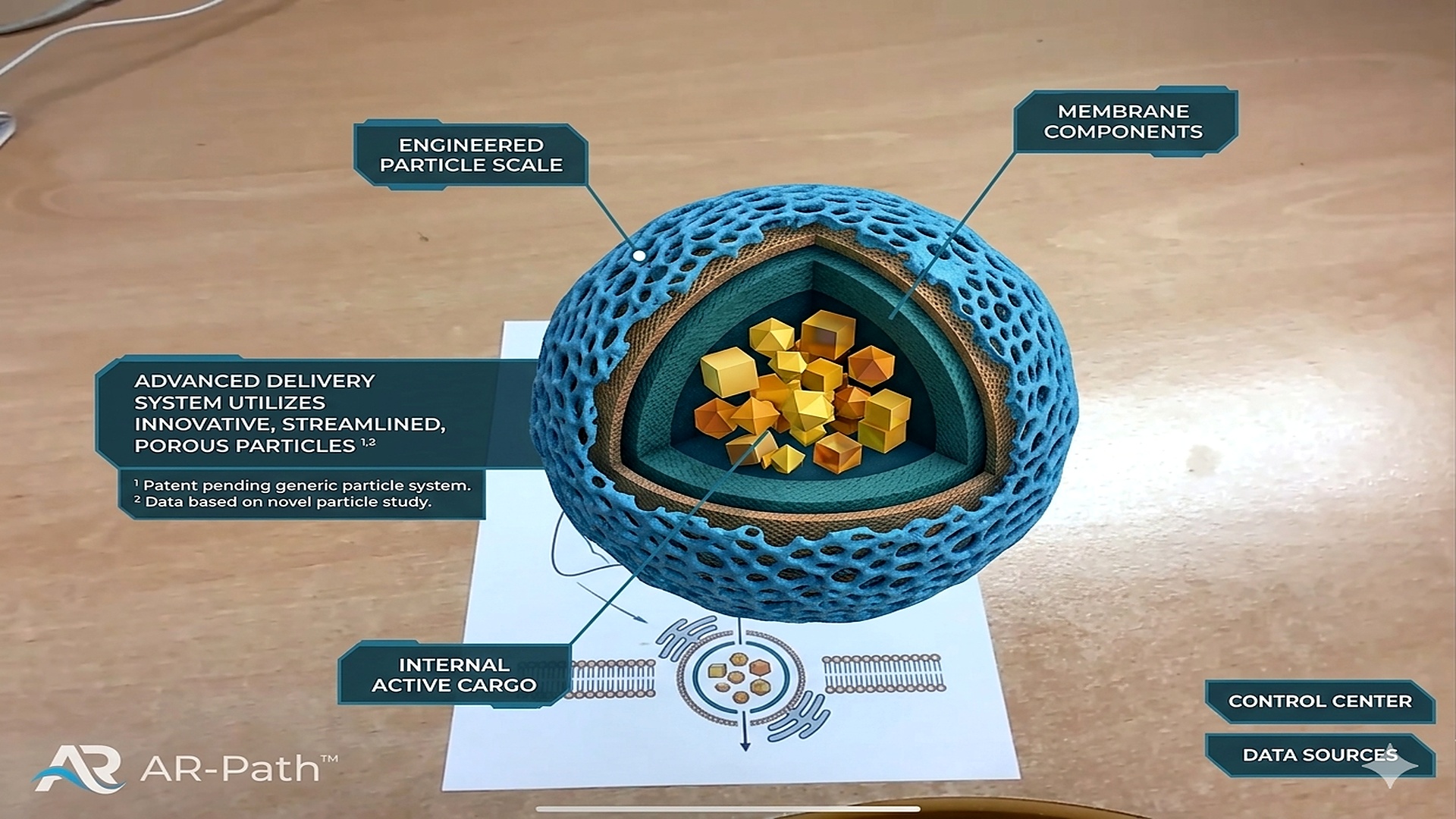
This respiratory AR tool gave AstraZeneca sales teams a demonstration of the delivery technology particle delivery that no printed leave-piece or slide could come close to.
What It Achieved
The brief was to communicate three specific proprietary delivery technology messages: aerodynamic particle size, delivery to both large and small airways, and consistent dosing with every use. The AR tool made all three tangible. Physicians could see particles travel through a 3D lung overlaid onto a physical model in the room in front of them. They could move the iPad around the target for a full 360-degree view, control the animation themselves, and tap into additional clinical detail at any point. Deployed across seven countries and adapted for both rep-doctor meetings and large-format congress use, it ran as a genuine selling tool rather than a novelty.
7
COUNTRIES DEPLOYED
Full multi-language build covering seven markets across Europe and beyond
3
MARKER TARGETS
3D printed lung model, aerodynamic particle and the delivery technology inhaler, all used as congress AR triggers
360
DEGREE EXPERIENCE
Full spatial AR: physicians could walk around the target and view the content from any angle
"The journey of the particles within the lungs really helped enhance the message of consistent delivery. Sales reps had something they could genuinely demonstrate rather than just describe."
CLIENT FEEDBACK · ASTRAZENECA RESPIRATORY · MCCANN HEALTH
// RECOGNITION & AWARDS
◆
Deployed as primary rep-facing digital sales aid across seven international markets
ASTRAZENECA RESPIRATORY · GLOBAL ROLLOUT
◆
Scaled up to a three-model conference installation for major respiratory congresses
ASTRAZENECA · CONGRESS PROGRAMME
Additional AR tools commissioned from the same programme
The app was part of a wider AR sales aid programme developed for AstraZeneca's respiratory portfolio. The modular build approach meant additional products and disease areas could be added to the same platform without starting from scratch.
Modular architecture reused across multiple respiratory products in the portfolio
Conference installation scaled up with three custom 3D printed model targets
Multi-language deployment across seven countries from a single codebase
The Context
// WHAT WAS NEEDED
AstraZeneca needed an AR tool that could operate in two very different environments: a one-to-one rep visit in a GP surgery and a busy international respiratory congress. It had to communicate three distinct delivery messages clearly, work without a technical operator, and be adaptable across seven markets. The 3D printed model approach was chosen to give the AR a physical anchor, something physicians could hold, look at and interact with, rather than pointing a tablet at a flat sheet of paper.
THE BUILD
I built the experience in Unity with Vuforia, creating a modular content architecture structured around the three core technology messages. Each module could be navigated independently, allowing reps to focus on whichever message was most relevant to a given conversation. The AR layer tracked onto either a 3D printed lung model or a flat card marker, giving deployment teams flexibility on cost and logistics.
- Vuforia-powered AR tracking onto both a 3D printed physical model and a flat card marker target: same experience, two deployment options
- Full 360-degree spatial AR: physicians could physically move around the target and view particle animations from any angle
- Modular content structure covering the three core brand messages: aerodynamic particles, small and large airway delivery, and consistent dosing
- Animated 3D particle tracking through the lung in real space, with tap-to-expand clinical detail at each stage
- Scaled conference version using three separate 3D printed models: full lung, aerodynamic particle close-up and the delivery technology inhaler
- Complete multi-language build across seven countries from a single Unity project with localisation support